Is Costco Gold Real? What You Actually Get When You Buy
LBMA-accredited refiners supply the metal directly to Costco warehouses.
VERISCAN optical recognition verifies PAMP Suisse gold without chips.
Forensic testing distinguishes real bars from tungsten counterfeits.
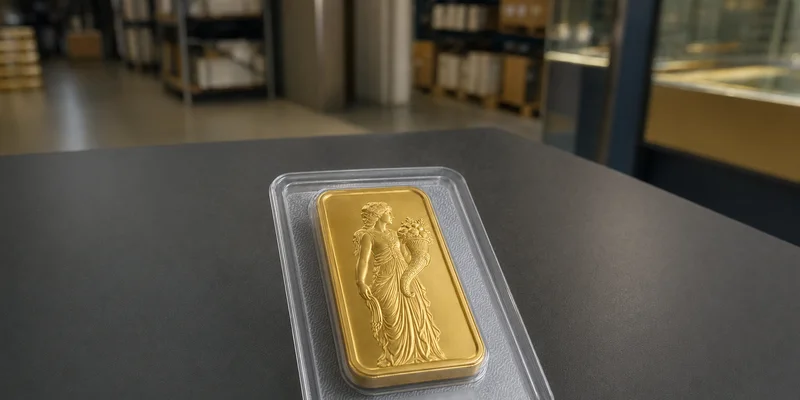
Yes — Costco gold bars are real. Every active gold bar SKU at the time of writing originates from an LBMA-accredited refiner, and PAMP bars (the largest share of Costco's lineup) carry an optical authentication system called VERISCAN that lets you verify the bar's surface fingerprint against PAMP's own database from your phone in under a minute.
The longer answer is more useful, because 'real' is doing a lot of work in that question. Buyers who ask it usually want to know three things: is the metal actually genuine, is it from a top-tier refiner, and how would you spot a fake if one ended up in your cart. This guide takes those questions in order, from the technical side — what the bar is made of, who made it, and how the verification systems actually work.
A note on scope: this article is about authenticity only. Restock timing, premium-over-spot pricing, and tax/storage strategy each get their own dedicated guides. Here we stay focused on what makes the metal real, what the assay card means, what VERISCAN actually does (and doesn't do), and where counterfeit risk genuinely lives — because there is real counterfeit risk in precious metals; it just doesn't live where most retail buyers fear it.
At the time of writing, Costco's lineup spans six LBMA-accredited refiners: PAMP Suisse, Argor-Heraeus, Valcambi, Rand Refinery, Royal Canadian Mint, and Perth Mint. Several of these are LBMA Referees — the elite tier of the Good Delivery system, responsible for testing other refiners' samples — which matters to a retail buyer because Referee status signals top-tier assay competence. The retail bars themselves aren't the wholesale 'Good Delivery' format; the refiners producing them have demonstrated the capability to meet that standard, and that demonstration is what backs the metal in your hand.
Authenticity Architecture: The Supply Chain and Refiner Standards
Every gold bar SKU on Costco's shelves at the time of writing comes from a refiner with LBMA Good Delivery accreditation. That accreditation isn't a marketing label. Refiners need a minimum annual throughput of 10 tonnes of refined gold, a tangible net worth of at least £15 million, and a track record of producing 400oz wholesale settlement bars to LBMA's exact specifications. Accreditation is reviewed periodically, and refiners commit to LBMA's Responsible Sourcing Programme — third-party audits of the supply chain for conflict-free origins.
What this means for a Costco buyer: the refiner producing your 1oz bar has been independently vetted on metallurgy, sourcing, and assay standards by the most authoritative body in the precious metals world. Your retail bar is a different format from the wholesale 400oz Good Delivery bar — but the operational standards behind it are the same.
Costco's active lineup at the time of writing spans six refiners. PAMP Suisse holds the largest presence (roughly 28 active SKUs in our 90-day tracking dataset), followed by Argor-Heraeus, Valcambi, Rand Refinery, Royal Canadian Mint, and Perth Mint. The exact SKU mix shifts with inventory turnover; the overall set of refiners has been stable. A handful of additional SKUs occasionally come from other LBMA-accredited refiners outside this core six, depending on stocking decisions.
Four of these refiners hold LBMA 'Referee' status — an elite role within the Good Delivery system. PAMP Suisse, Argor-Heraeus, Rand Refinery, and Perth Mint are all Referees, meaning they test reference samples and assess applicants for new accreditation. For a retail buyer, that signals top-tier assay competence: the LBMA itself relies on these facilities to test other refiners' work. Perth Mint additionally holds weight master and assayer accreditation across all five major precious-metals exchanges (LBMA, COMEX, Shanghai, Tokyo, Dubai).
Counterfeit risk on the Costco supply chain is much lower than on typical secondary-market channels (eBay, pawnshops, classifieds). Bars travel directly from refiner to wholesale distribution to warehouse floor; for a counterfeit to land in your cart, it would need to pass through that closed-loop chain. That's a meaningfully harder path than slipping into the open secondary market. Costco's internal supply-chain controls aren't fully auditable from public information, so 'much lower' is the honest framing — not 'zero'.
VERISCAN and PAMP Authentication: Optical Recognition vs. Misconceptions
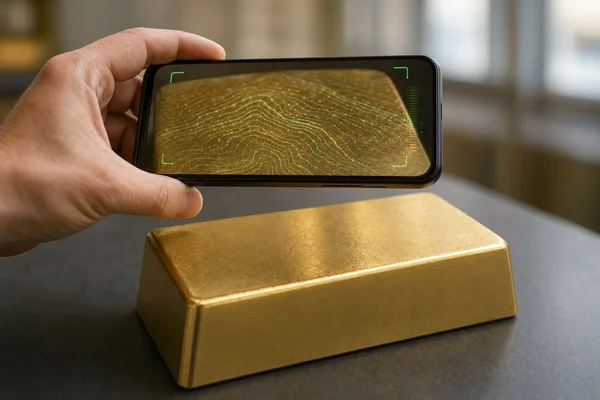
VERISCAN is an optical authentication system PAMP built into its bullion line. The bar's microscopic surface — the unique pattern of imperfections left by casting and stamping — IS the fingerprint. PAMP captures that pattern at the mint and stores it in their database. Verification is a lookup: a fresh scan from your phone (or a flatbed scanner) matches against the stored reference image.
What it isn't: NFC, RFID, a blockchain, a cryptographic ledger, or a one-time-use token. The bar carries no chip, no embedded signature, no state. The verification record sits on PAMP's servers, separate from the metal.
Packaging is a practical convenience, not part of the authentication. The bar can be scanned inside its sealed CertiPAMP card OR removed entirely — the surface pattern works either way. Larger PAMP bars allow six-sided scanning for higher confidence; smaller bars rely on the single-face fingerprint, which is still unique to the casting.
Forensic Reality: Assay Cards, Counterfeit Signals, and Physical Verification
The CertiPAMP card is a tamper-evident assay certificate displaying the bar's serial number, exact weight, purity (.9999 fine), and the certified assayer's printed signature. Removing the bar voids the certificate's resale value but doesn't disable VERISCAN — the optical authentication still works.
The main physical counterfeit threat in gold is tungsten. Tungsten's density (~19.25 g/cm³) is within 0.26% of gold's (~19.32 g/cm³), so a tungsten core wrapped in a gold shell will pass simple weight-and-volume tests. That tiny density gap is what makes ordinary 'feel' or specific-gravity tests unreliable for high-value bars.
Two complementary tools handle this. XRF measures surface composition and catches plated or clad fakes — but only penetrates 10–50 microns, so it can't see a tungsten core hidden under a thick gold layer. Ultrasound velocity testing fills that gap: gold's sound velocity is ~3,240 m/s, tungsten's is ~5,170 m/s, a roughly 60% difference that a handheld ultrasonic gauge detects easily. Dealers typically run both — XRF for the surface, ultrasound for the interior. Ultrasound is one strong tool in this protocol, not the single definitive method; the combination is what closes the blind spots.
On the packaging side, sophisticated counterfeit PAMP Fortuna bars exist on secondary markets, sometimes with convincing assay cards. A few visual checks help separate genuine from fake:
• Smooth card edges where the background color extends to the border. Counterfeits typically show crimped plastic edges that extend past the colored portion.
• A clear window around the bar. Counterfeits usually have a solid white border instead.
• Stamped serial numbers — small dots, not laser-engraved text.
• Blue ink for lettering and the PAMP logo. Older counterfeits used black ink; newer ones have improved, so this is a hint, not a definitive test.
• On the PAMP logo specifically, the swooping line stays above the first 'P'. On counterfeits it commonly touches the top of the 'P'.
Counterfeit risk on the Costco channel is much lower than on typical secondary-market channels — the closed supply chain from refiner to warehouse floor is genuinely hard to inject a fake into. That said, internal supply-chain controls aren't publicly auditable in detail, so 'much lower' is the honest framing rather than 'zero'. If you're ever buying secondhand from an open marketplace, run XRF + ultrasound — that's the standard dealer protocol for a reason.
Conclusion: The Verdict on Costco Gold Authenticity
So: are Costco gold bars real? Yes. The metal is genuine, the refiners producing it are independently vetted on quality and sourcing, and PAMP bars come with optical authentication that lets you verify them yourself.
What you actually receive: a heavy, precisely stamped bar from one of six LBMA-accredited refiners, sealed in a tamper-evident assay card with a serial number, weight, purity, and the certified assayer's signature. The verification chain is the refiner's accreditation, the assay card, and — for PAMP products — VERISCAN's optical pattern match against the mint's database.
Counterfeit risk lives in secondary markets, not on the Costco channel. The closed supply chain from refiner to warehouse floor is much harder to inject a fake into than open marketplaces, where convincing counterfeit PAMP bars with valid-looking assay cards have been documented. If you ever resell into the secondary market, expect the buyer to run XRF and ultrasound — and run them yourself if you're buying there.
For a Costco buyer: verify the refiner stamp on the bar, check the assay card for the visual cues above, and run VERISCAN if the bar is PAMP. Three quick checks, and the question is settled.
About Gold Restock Alerts
We help shoppers and resellers stay ahead by tracking Costco gold inventory. Our alerts ensure you’re the first to know when high-demand gold SKUs are back in stock, so you can buy before they sell out.